Unexpected Downtime: Its Impact and Costs
BY: TINA LIN
Fleet managers give so much time and attention to planning for preventative maintenance repairs that, when unexpected downtime occurs, it easily becomes a major grievance. This problem is present for every fleet manager, whether you are a manager of 5 or 500. Expected downtime resulting from preventative maintenance alone is a big issue since fleet vehicles are ‘down’ for a period of time, leaving operators without a vehicle. However, the scheduled downtime keeps lost productivity and incurred costs to a minimum because fleet managers can plan around it.
On the other hand, unexpected downtime resulting from a crash becomes a far more time-consuming and costly situation. We’ll walk you through how unexpected downtime negatively impacts repair cycle-time and your bottom-line. first and discuss the financial implications associated with it. Then, we will show what smart fleets are doing to reduce their unexpected downtime while simultaneously driving down costs, improving quality, and supporting local, diverse repair shops.
Unexpected vs. Expected Downtime
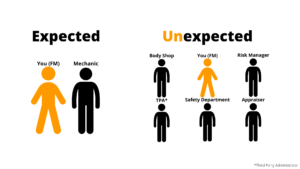 With expected downtime, there is a schedule and a plan to work around the preventative maintenance and thus less people are involved in comparison to unexpected downtime. Additionally, you likely have discussed the required maintenance with your in-house mechanic prior to the vehicle being down. Preventative maintenance (PM) also does not require input for multiple internal departments like risk and safety and other third party vendors like appraisers and Third Party Administrators (TPAs). With unexpected downtime, there is no plan. There is simply no way to schedule a crash. Here, we examine in detail what makes unexpected downtime so wasteful in time and cost.
Manual Paper Incident Reporting Process
Paper incident reports are the most traditional and common way operators are recording crashes. But, manually writing reports can easily become a hassle. Not only can departments lose or erroneously file away reports, but also the reports may leave out important details or be misinterpreted because of handwriting. In addition, paper reports can take up to several weeks to complete.
If an incident report is not on file, the vehicle cannot be fixed in a timely manner. Even under the circumstance that the vehicle is not immediately out of commission, the damages it has endured in the specific crash can lead to future issues where the vehicle breaks down unexpectedly.
Time Spent Waiting on Independent Appraiser or Third Party Administrator
Your goal is to keep your fleet on the road, thus crashes become the most frustrating cause of downtime. Oftentimes, when a crash occurs, multiple departments have to look over an incident report before the vehicle can return to the road. If departments lose the incident report, you and the risk manager must chase down the information. This directly impacts your productivity and creates a bottleneck.
For some, the departments involved include the following: the safety department, fleet management, a repair shop, risk management, independent appraisers, and third party administrators. With this many people involved, it is easy for a vehicle to stay idle for a long period of time. Downtime is heavily impacted by wait times between departments, but this is even further exacerbated when there are outside organizations involved. Independent Appraisers and TPAs work outside of your organization which makes them difficult to communicate with.
The Costs Behind Unexpected Downtime
Expected downtime comes with a set budget, and you can easily know the costs of each repair. However, not only do crashes prevent vehicles from staying on the road, but also hide a plethora of hidden costs. This easily drives up downtime costs. The most obvious cost is the accident related costs, which approximately total to $70,000 for a single accident, according to an article written by SHzoom.
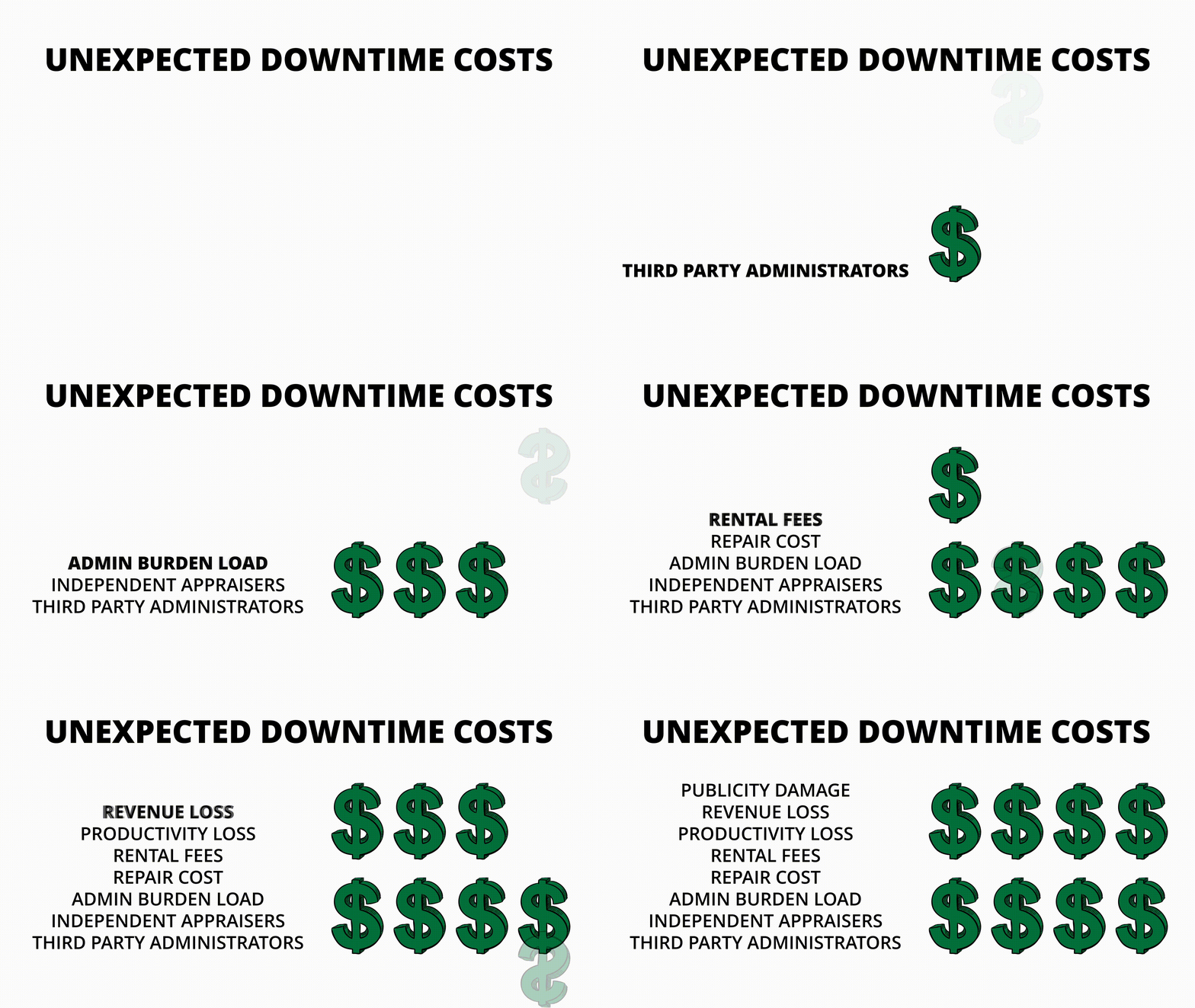
However, $70,000 does not include the hidden costs of crashes. While the costs of administration burden, productivity loss, and publicity damage are not easily quantifiable, these all impact downtime costs. It is important to keep this in mind when dealing with unexpected downtime.
The Key to Reducing the Impact and Costs
During an initial pilot UPtime held with Montgomery County, over a one year period, the overall cost Montgomery County was spending to handle incidents was $24.2 million. The study was based on a 65 incidents per month average. If we view this over a 5-year period, Montgomery County will spend $121 million just for crash related costs.
However, by usingUPtime, Montgomery County was able to reduce their cycle times by an average of 28.4 days. They were also able to gain access to a much more diverse group of suppliers that better reflected their community. In speaking with Wilniq, a body shop, we learned that UPtime promotes transparency for community members. Wilniq works closely with Montgomery County for their vehicles. UPtime does this through providing a platform for MFD-owned (Minority, Female, Disabled) body shops to submit estimates for crashes.
Smart fleets should have automated technology to store data so that, as a fleet manager, you are saving time and preventing human errors. Don’t do this by yourself, though. Let UPtime help with that. Learn more on how UPtime decreases downtime and mention “unexpected downtime” in Additional Information to get started today.
Citations:
“SHZOOM RECORDS ANOTHER LANDMARK ACHIEVEMENT WITH THE LAUNCH OF SHZOOM FLEET ACCIDENT MANAGEMENT SYSTEM.” ABNewswire, 15 Apr. 2019, www.abnewswire.com/pressreleases/shzoom-records-another-landmark-achievement-with-the-launch-of-shzoom-fleet-accident-management-system_355527.html.